Unlicensed Auctions Are Everywhere — Here’s What Buyers and Sellers Should Know
The estate industry is booming. As baby boomers downsize and generational wealth transfers accelerate, the volume of personal property moving through auctions and estate sales has reached levels not seen in decades. But alongside that growth, a troubling trend has emerged: a rising number of unlicensed operators conducting auctions without the state credentials required by law.
In Florida, anyone who conducts an auction — whether in person, online, or hybrid — is required to hold a state-issued auctioneer license (AU) and operate under a registered auction business license (AB). These licenses are not optional. They are mandated by Florida Statute Chapter 468, Part VIII, and enforced by the Florida Department of Business and Professional Regulation. The licensing process requires education, examination, background checks, and ongoing compliance. It exists to protect both buyers and sellers from fraud, misrepresentation, and financial loss.
Despite this, unlicensed auctions are surprisingly common. You will find them on social media marketplaces, in rented event spaces, and even operating out of storage facilities. Some present themselves as “estate sales” to sidestep auction regulations, while others simply ignore the law entirely, counting on the fact that most consumers do not know the difference. The problem is not limited to Florida — nearly every state has its own auction licensing requirements, and violations are widespread nationally.
Why should you care? Because when you buy from or sell through an unlicensed auctioneer, you have almost no legal recourse if something goes wrong. Licensed auctioneers are held to standards of conduct, required to maintain trust accounts for client funds, and subject to regulatory oversight. If a licensed auctioneer mishandles your consignment or misrepresents a lot, you have a clear path to file a complaint and seek resolution through the state. With an unlicensed operator, you are on your own.
For sellers, the risks are even more significant. Unlicensed operators may commingle your sale proceeds with their own funds, fail to provide accurate accountings, or simply disappear with your property. Estate executors and personal representatives have a fiduciary duty to the estate — using an unlicensed auctioneer can expose them to personal liability if assets are lost or undervalued.
For buyers, the concerns are different but equally real. Unlicensed auctions often lack the expertise to properly identify, authenticate, and describe what they are selling. Without professional cataloging, you may overpay for misattributed items or miss condition issues that a trained cataloger would have disclosed. There is also the question of provenance — licensed auction houses maintain records and follow legal requirements around stolen property checks that unlicensed operators typically do not.
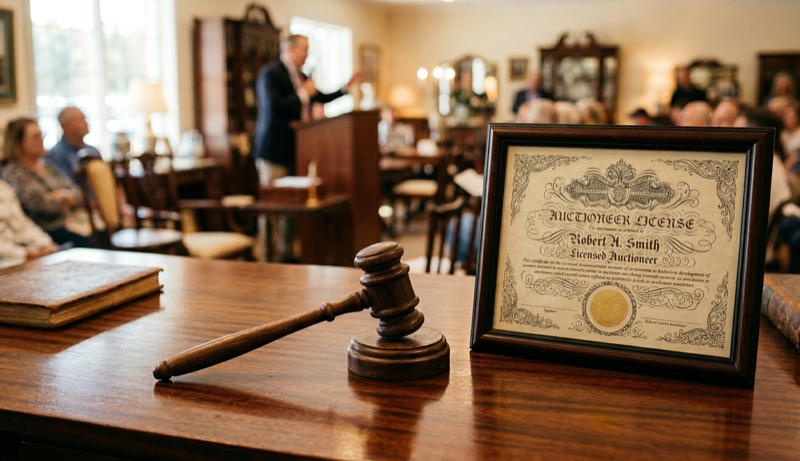
So how do you protect yourself? Start by asking one simple question before you bid or consign: “Are you licensed?” In Florida, you can verify any auctioneer’s license status through the DBPR’s online portal in seconds. A legitimate auction house will display their license numbers prominently — on their website, in their terms of sale, and on their marketing materials. If you cannot find a license number, that is a red flag.
Look for other indicators of professionalism as well. Does the auction house publish clear conditions of sale and a buyer’s premium structure? Do they provide detailed lot descriptions and multiple photographs? Do they have a physical business address and a verifiable track record? Are they affiliated with professional organizations like the National Auctioneers Association or the Florida Auctioneers Association? These are signs that you are dealing with a legitimate operation.
At Ageless Auctions, we hold Florida Auctioneer License AU5181 and Auction Business License AB3948. Our license numbers are on every page of our website, in our auction terms, and on every catalog we publish. We maintain a separate trust account for all client funds, carry liability insurance, and comply fully with Florida auction law. We believe transparency is not a selling point — it is a baseline requirement.
The estate industry serves an important role in preserving and redistributing the material culture of our communities. But that role only works when it is conducted legally, ethically, and with proper accountability. Before you bid at your next auction or hand over a loved one’s collection for sale, take thirty seconds to verify that the people handling your property are actually authorized and properly licensed in the state of Florida to do so. It is the single most important step you can take to protect yourself.